Safe Steps at Heights: The Essential Mobile Scaffolding Systems for Industry and Construction Sites
When it comes to construction, industrial facility maintenance, installation, and facade renovation projects, one of the most fundamental operational challenges that comes to mind is accessing high points safely and flexibly. Throughout history, traditional steel scaffolding or wooden structures have been preferred for such vertical work. However, in today's fast, cost-oriented modern projects where occupational safety standards are kept at the highest level; these classic systems, which are heavy, take days to install, and are cumbersome to transport, are leaving their place to much more agile solutions.
Right at this point, mobile scaffolding systems come into play, bringing a revolutionary breath to the sector with their lightness, modular structure, and wheeled design. Going far beyond just being a climbing tool; these rolling platforms, which protect the occupational safety of employees at the maximum level while dramatically shortening the operational time, are among the indispensable fixtures of today's engineering world. In the light of the high engineering products offered by Sinerji Scaffolding, one of the leading brands in the sector, let's examine the technical superiority of aluminum mobile scaffolding, its usage areas, and the intricacies of choosing the right system in full detail.
1. From the Dead End of Traditional Steel Scaffolding to the Lightness of Aluminum
In construction sites or large industrial facilities, the weight and transportation difficulty of scaffolding systems are among the issues that maintenance and repair teams complain about the most. Traditional steel pipe scaffolds create serious logistics costs during the transportation phase due to the high weight per piece and consume the physical energy of the teams during the assembly-disassembly processes.
Designed with an innovative aluminum body architecture, mobile scaffolding solutions bury these chronic problems in history. Bringing together the low specific weight of aluminum and structural strength in perfect balance, these systems;
-
Can be transported effortlessly by a single operator or a small team thanks to their lightweight parts.
-
Save labor by minimizing installation and dismantling times.
-
Can be used safely for many years by showing superior resistance against corrosion and harsh weather conditions thanks to its special alloy structure.
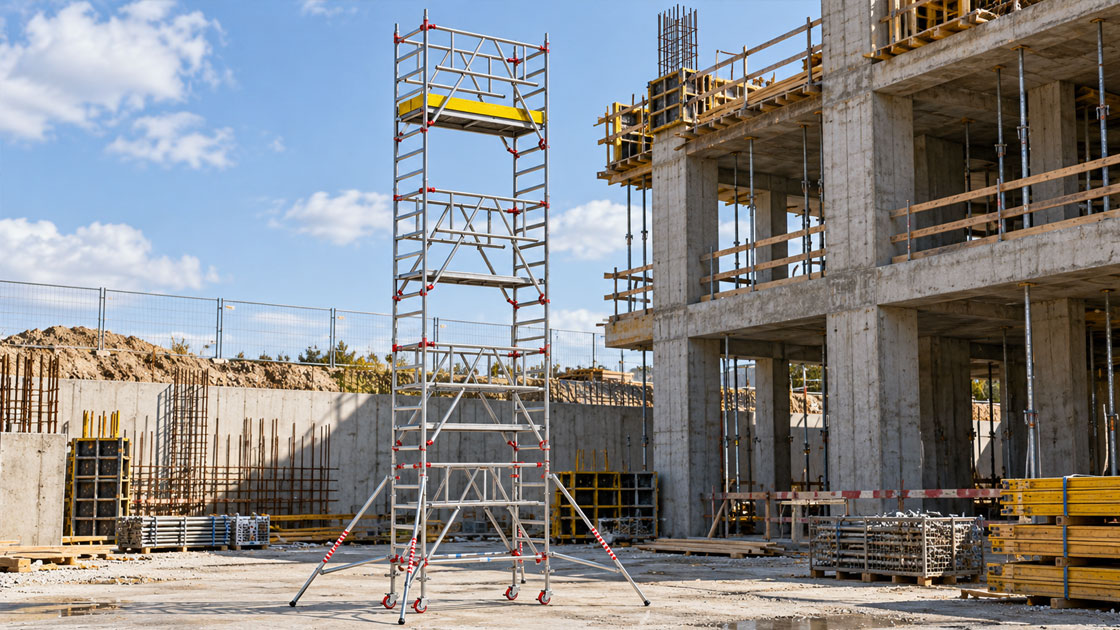
2. Anatomy of Mobile Scaffolding Systems: What are the Core Components?
A safe and functional rolling scaffold system consists of integrated parts designed in accordance with international standards. The basic building blocks involved in a mobile scaffold installation are:
-
Vertical Load-Bearing Frames: These are high-strength aluminum vertical profiles that form the main skeleton of the scaffold.
-
Horizontal and Diagonal Bracing Elements: Lockable connecting rods that provide the rigidity of the system and prevent the scaffold from swaying or bending.
-
Working Platforms: Special platforms with or without hatches, with a non-slip surface, on which personnel and equipment stand safely.
-
Guardrail Systems: Top and intermediate guardrail bars surrounding the platform to prevent employees from falling from a height.
-
Access Ladders: Integrated ladder systems that allow employees to safely climb up and down the platform.
-
Wheels and Braking Mechanisms: Heavy-duty wheels that allow the scaffold to be easily moved from one point to another and offer a safe stance by locking when fixed.
-
Stabilizer Support Elements (Outriggers): Adjustable foot supports that prevent the scaffold from tipping over depending on the height and ensure it stands firmly on the ground.
3. Sinerji Scaffolding Solutions: Superior Performance with S Pro and Rise Series
Every project involves a different height, area width, and operational requirement. Sinerji Scaffolding offers engineering solutions specific to every sector and working condition with the S Pro, S Pro Safe, and Rise systems it has developed in the mobile product group.
S Pro Small and X Small: The Savior of Narrow Spaces
-
S Pro Small: Offers compact working opportunities at heights between 4 and 10 meters. Thanks to its compact platform measuring 2500x750 mm, it is a perfect choice for jobs requiring high access in narrow corridors and restricted areas.
-
S Pro X Small: It is a practical and quick-to-install model that reduces assembly and disassembly times to almost zero thanks to its folding body structure. It provides maximum efficiency in emergency maintenance and repairs within the facility.
S Pro Large: Wide Working Areas and High Access
-
Offering a working height between 4 and 14 meters, S Pro Large is designed for large-scale industrial facilities, factories, and structures with high ceilings. Its wheeled and outrigger structure offers perfect balance and mobility in both indoor and outdoor spaces. With its TSE and TÜV certified structure, it fully meets international safety norms.
4. Usage Areas of Mobile Scaffolding: Industry, Factories, and Construction Sites
One of the biggest advantages of aluminum mobile scaffolding is that it can be used flexibly across a very wide range of sectors. In areas where the installation of traditional fixed scaffolding is impossible or too costly, rolling scaffolds are lifesavers:
-
Production Facilities and Factories: Provides safe access for periodic maintenance and repairs of pipelines, cable trays, lighting systems, ventilation ducts, and fire installations passing through factory ceilings.
-
Warehouses and Logistics Centers: In case of lighting malfunctions, camera system installations, or shelf maintenance in high-bay warehouses, it can be quickly moved to the relevant aisle and installed without interrupting the workflow.
-
Interior Finishing and Decoration Works: Allows workers to easily change their working points throughout the day in drywall, painting, whitewashing, sound insulation, suspended ceiling, and mechanical installation works.
-
Hotels, Malls, and Public Spaces: In commercial buildings with large atriums and common areas with high ceilings, it offers the opportunity to carry out fast and aesthetic maintenance without hindering the daily activities of the business.
5. Things to Consider When Choosing the Right Mobile Scaffold
Determining the most suitable scaffolding system for your project is a critical step in terms of both budget optimization and occupational safety. During the decision-making process, the following criteria must be evaluated meticulously:
-
Working Height: The maximum point to be reached and the platform height must be calculated correctly. Depending on your needs, different versions from 4 meters to 14 meters should be evaluated.
-
Space Conditions (Indoor/Outdoor): Is the work area a closed factory floor or an exterior facade exposed to wind? In outdoor applications, systems with outriggers must be preferred by taking the wind load into account.
-
Ground Structure: Is the ground smoothness suitable for the scaffold to move safely with its wheeled structure? Telescopic adjustable feet should be used on sloping grounds.
-
Load on the Platform: How many personnel will work simultaneously on the platform, and how much equipment (heavy tools, material boxes, etc.) will be kept? Models with a carrying capacity suitable for the load class should be ed.
-
Ease of Storage and Transportation: Will the scaffold be frequently dismantled and transported to different construction sites, or will it be moved around the factory in one piece? This question guides the preference for folding models.
6. Vital Occupational Safety Rules in the Use of Mobile Scaffolding
No matter how safe a high-quality mobile scaffold with TÜV and TSE certificates is, the rules that users in the field will follow play a vital role in preventing possible accidents. The basic safety rules that stand out with the expert recommendations of Sinerji Scaffolding are as follows:
-
Never Move While There are Workers on It: The most common rule violation of a mobile scaffold is trying to change its place by pushing the scaffold while there are personnel on it. When the scaffold is to be moved, there must be absolutely no one on the platform.
-
Locking the Brakes: When the scaffold is brought to the desired working point, the wheel brakes must be securely locked and the scaffold must be prevented from moving.
-
Ground Inspection: Before moving the scaffold, cables, rubble, or obstacles on the ground must be cleared, and rough patches where the wheels might get stuck must be eliminated.
-
Wind and Weather Conditions: In outdoor operations, the use of high mobile scaffolding must be stopped strictly in adverse weather conditions such as strong wind and storms, and the system must be taken to a safe anchoring point.
-
Guardrails and Toe Boards Must Be Complete: When stepping onto the working platform, the guardrails and toe boards (skirting) must be fully installed, and the use of safety harnesses must not be neglected.
A Safe Future with the Right Engineering and Quality Infrastructure
Saving time, reducing occupational accidents to zero, and taking operational efficiency to the top in the construction and industrial maintenance sectors start with choosing the right equipment. Lightweight, modular, and TSE-certified mobile scaffolding solutions, which have replaced traditional and cumbersome steel systems, are the strongest trump cards of modern projects.
Offered with the assurance of Sinerji Scaffolding, the S Pro and Rise series aluminum rolling scaffolds provide a safe, fast, and flexible working area for your teams even under the most demanding construction site conditions. If you want to optimize the vertical access needs in your projects, take occupational safety beyond standards, and make a permanent investment; meet professional aluminum mobile scaffolding systems and secure your confidence at heights.